190,000 New Mexicans, 9% of the state population, have no form of health insurance.
Federal reform from the ACA halved New Mexico’s uninsured rate from 18% to 9% from 2013 to 2016. However, in 2017 the rate stagnated, and in 2018 there was a slight rise in the percentage of uninsured. New Mexico needs comprehensive, sustainable, state-level reform to retain the impact of the ACA and further reduce the uninsured rate.
Who are the uninsured?
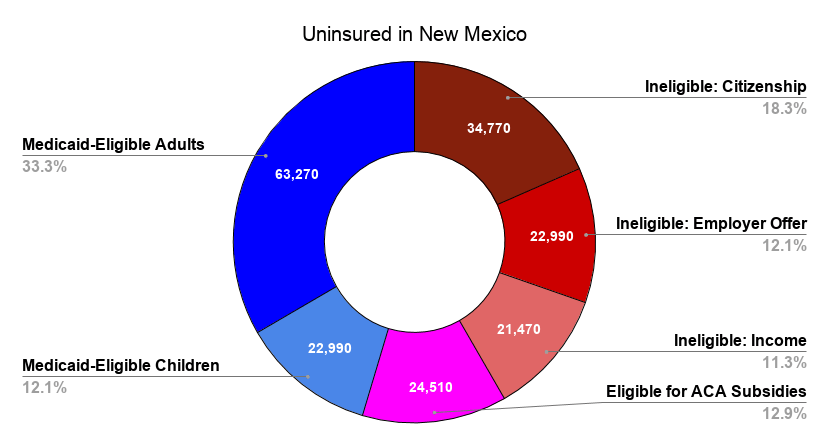
The chart below shows the composition of those without health inurance in New Mexico. About 45% are Medicaid-eligible and 13% are eligible for federal marketplace subsidies. This means over half of the uninsured are eligible for free or subsidized coverage but are not utilizing it. The other 42% are ineligible for Marketplace subsidies. The rest are facing other accessibility or affordability issues. Research shows only 2% of those without insurance do not want coverage. How can New Mexico reach the 98% who want coverage but don’t have it?
Comprehensive state reform: 3 integrated policies.
After reviewing policy options from around the country, my recommendation for New Mexico is to adopt a 3-part reform over the next few years.
The first component is a Targeted Medicaid Buy-In. This would make Medicaid available for purchase to those who do not qualify for Medicare, Medicaid, or federal subsidies for private coverage. This option would sell Medicaid coverage at cost, and the state can decide to subsidize this as much or as little as desired, by sliding scale or a fixed amount. If priced correctly, this could provide a source of affordable, comprehensive coverage for those who lack accessibility to the Marketplace. Governor Lujan Grisham has explicitly mentioned a Medicaid buy-in within her plan to reform health insurance, and the state legislature funded a study of four versions of the buy-in, concluding that this one was the best first step.
The second component is Medicaid auto-enrollment. This can be modeled three ways. SNAP-based, tax-based, or a combination of both. The SNAP-based option is modeled after a Louisiana program that streamlines Medicaid enrollment for children through SNAP benefits. Applying it to adults, it would work like this: if an individual has SNAP and is not insured, they would be sent a Medicaid card. They would technically be enrolled and consent to that enrollment the first time they use the card, and would then be able to opt-in or opt-out for the following year. The tax-based option would involve a check box on the NM income tax form asking for affirmative consent to use the information on the form to check for Medicaid eligibility, and if eligible, sign them up automatically. A combination of these two would comprehensively capture the Medicaid-eligible population and help with retention. The tax-based idea has already been considered as a part of a proposal in New Mexico, which is the next component of my recommendation.
The final component is the Shared Responsibility Requirement with Down Payment and Auto Enrollment options. Under this policy, individuals would be mandated to maintain insurance, similar to one of the original (since removed) components of the Affordable Care Act. The difference is that with this policy, if an individual has not maintained insurance and is subject to the financial penalty, they would get the option to use the money as a down payment for insurance for the following year. If they opt-in to this, they have two weeks to pick a plan. If they do not pick a plan within the two weeks, they will be automatically enrolled in the highest value plan that is covered entirely by their down payment and any federal subsidies they qualify for. BeWellNM, the state’s Marketplace exchange for private health coverage, created a task force to study this option in 2018. A bill was drafted but was pulled by the task force before committee, citing the need for more research about the interactions between agencies this option would necessitate. Advocates are planning on studying the option in depth for legislation in the 2021 session.
Combined, these policies would capture all uninsured populations and do so in a comprehensive, low risk manner. Advocates would have a lot of work on their hands though; the Shared Responsibility and Medicaid auto-enrollment particularly come with administrative difficulties and uncertain political feasibility. A successful campaign would engage all involved entities for these plans, including providers, insurance carriers, beWellNM, NM Tax and Revenue, and the uninsured themselves to contribute meaningful input and elicit support. The policies are likely to face resistance from some of these groups, as well as from other entities that traditionally oppose healthcare reform. However, the payoff could be massive if these plans are implemented. Not only would the state be considered a leader in healthcare reform, but it would sustainably and significantly reduce the uninsured rate in New Mexico, improving the health and lives of our workforce, our families, and our communities.
 NM Health Policy by Rivera